The Guest List: The Lost Art of the Dinner Table

The Guest List | Linkedin Newsletter
We haven't lost the dinner table. We may, however, have started forgetting what it's for...
Eating has become remarkably efficient. Lunch is consumed at a desk between emails. Dinner can arrive at the front door without requiring conversation with another human being. Children can turn up, eat and leave with considerable skill without ever detaching their eyes from their iPhones.
This is undeniably convenient. But somewhere along the way, we've started treating food primarily as fuel and eating as another task to optimise.
For families, the dinner table was once the rather unavoidable daily meeting. You sat down. You asked how everyone's day had been. You scolded your children. You discovered what was happening in each other's lives, sometimes whether you particularly wanted to or not.
But I thought I would talk about another use for the table... Putting people around it who might otherwise never meet.
The psychology of sitting down together
A friend of mine organises a dinner every month.
There's nothing particularly complicated about it. He chooses a restaurant, brings together people from different walks of life and everyone pays their own way. There's no commercial objective. Nobody is sponsoring it. There isn't a presentation between the starter and main course. People simply turn up.
I went to one recently and found myself thinking about how extraordinarily powerful this very ordinary thing can be. People who might otherwise never have met were exchanging ideas, telling stories, making introductions and genuinely enjoying one another's company.
And it turns out there is some psychology behind this.
Research from Oxford University has linked eating socially with greater feelings of trust, happiness, social connection and having more people to depend upon. Professor Robin Dunbar has also written about activities including feasting, laughter and storytelling engaging the brain's endorphin system, part of the machinery involved in human social bonding.
Perhaps even more interestingly, researchers studying strangers found that people who ate from shared plates subsequently cooperated more during negotiations than people eating exactly the same food from separate plates.
A meeting has an objective. A coffee usually has a time limit. Networking has the faintest sinister implication that you're both supposed to establish whether the other person might eventually be useful to you. Dinner gives conversation somewhere else to go.
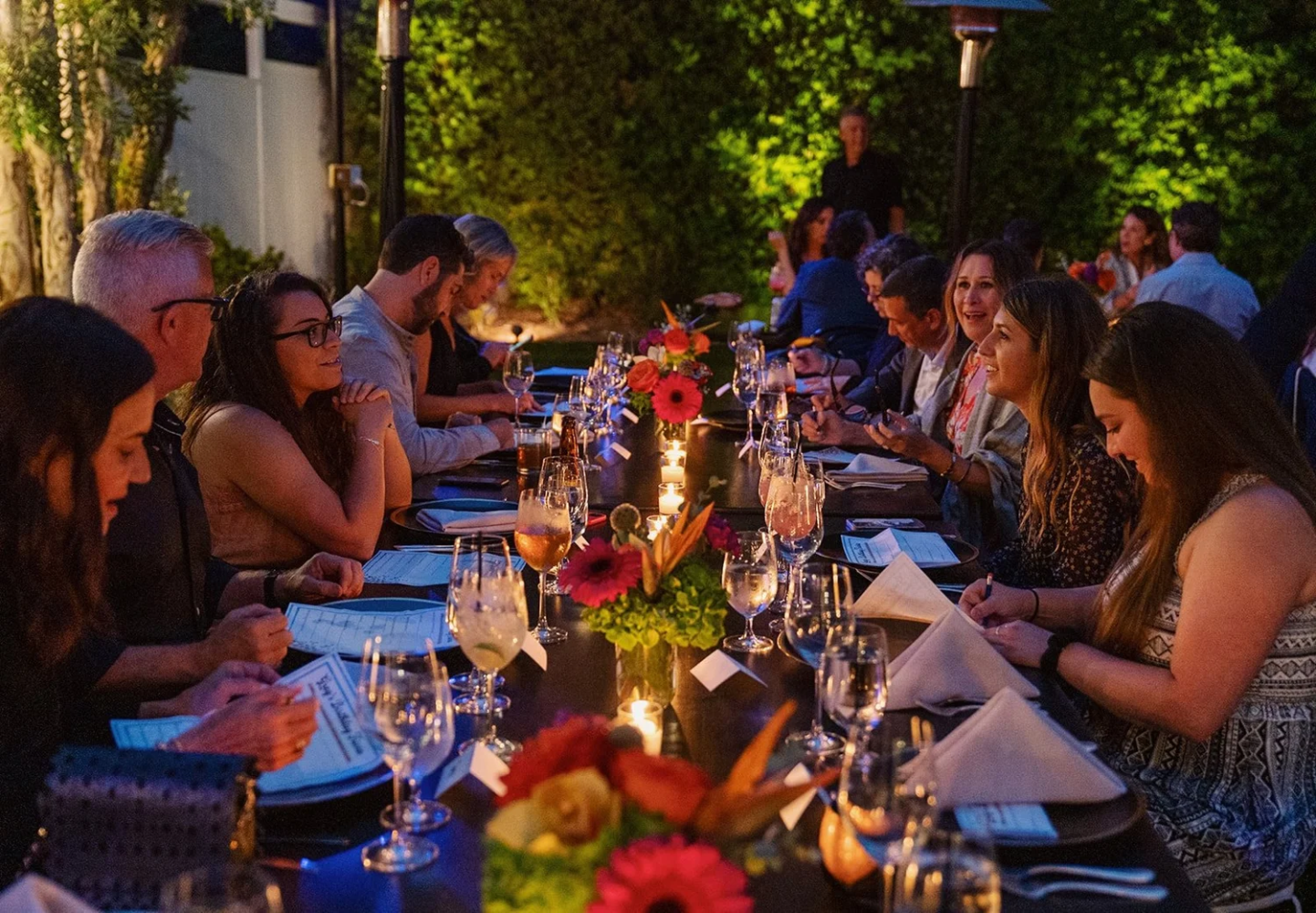
Outdoor Dinner
The most impressive guest list isn't always the best one
I've planned many events involving dinners, and one thing became apparent fairly quickly: The most impressive guest list isn't necessarily the best guest list.
It's tempting, particularly in business, to construct a table by job title. CEO. Founder. Chairman. Investor. Another CEO for good measure. It looks excellent on paper. Unfortunately, people don't experience dinner on paper.
Great tables have chemistry. You need variety. The quirky one. The funny one. The person who's travelled everywhere. The storyteller. The person who asks unusually good questions. Occasionally even somebody who disagrees with everyone else. A good guest list isn't a ranking of the people you'd most like to impress. It's a calculation of who might bring something interesting out of everyone else. That applies whether you're hosting a corporate dinner or having six people around your kitchen table.
Business, friendship and dating
Some of the most important relationships in our lives develop around tables. Business certainly does. You can learn someone's professional biography from LinkedIn in approximately thirty seconds. It takes a fair while longer to discover what they're curious about, what makes them laugh, where they've been, what they believe and whether you actually enjoy their company. Friendships work much the same way. And then there's dating.
We've developed extraordinarily sophisticated technology to help us find another human being. Algorithms can filter thousands of potential partners by age, interests, geography and whether they claim to enjoy hiking despite apparently never having been near a mountain. And having deployed all this technology to find our supposed match, what do we do? We put two chairs on opposite sides of a table and see whether they can talk to each other.
Dinner reveals people. Do they listen? Are they curious? How do they treat the person serving them? Can they ask a question? Can they tolerate silence? And, perhaps the most reliable measure of all, does three hours feel like twenty minutes... or does twenty minutes feel like a hostage situation?
You don't have to work the room
Not everybody enjoys walking into a room containing fifty strangers. The traditional advice to "work the room" sounds perfectly reasonable if you're naturally extroverted. To somebody who isn't, it can sound less like professional development and more like a punishment. A table changes the dynamic.
You don't have to circulate or manufacture an elegant way of interrupting a group of strangers. You don't need an elevator pitch. You sit down. Six people around a table can provide something a room of two hundred often doesn't: enough time to actually get to know somebody.
And being a good host doesn't require being the most interesting person at the table... It requires being interested in everyone else at it.
Candlelit Dinner
The art of curating people
Perhaps that's a better way to think about hosting. It isn't really about the food.
A wonderful friend of mine, Judith Blacklock, runs a prestigious floristry school in Knightsbridge in London. When I first met Judith nearly two decades ago, one of the things that fascinated me was her extraordinary ability to assemble the most eclectic groups of people. Every few weeks, people would gather in her office for drinks before heading somewhere for food.
There seemed to be no obvious logic to the guest list, which was precisely why it worked. I remember Judith introducing me to one gentleman with an American accent. She whispered into my ear ('HE WORKS FOR THE CIA'!). Another was a local artist. Then there would be lawyers, creative industry leaders and people from completely unrelated worlds. I can't remember what we ate. I remember the people.
Judith understood something that I've come to appreciate more with time: connection can be curated. You don't need everybody to have something obvious in common. Sometimes the whole point is that they don't.
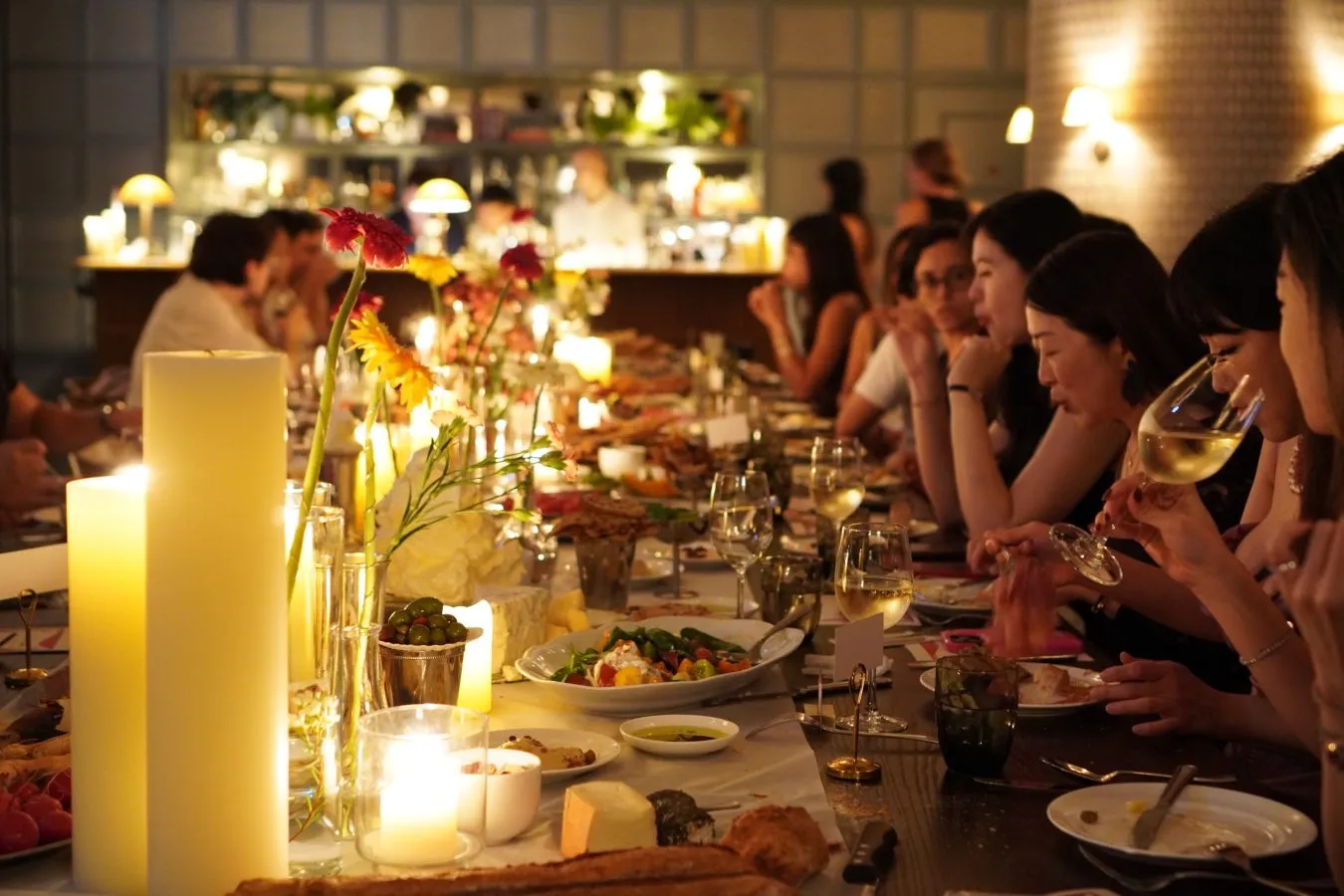
Private Dinner
Put someone new around your table
So perhaps we should stop thinking about dinner simply in terms of who we already know. Choose a restaurant. Pick six or eight people. Mix the guest list. If it's personal, ask two friends to bring someone you haven't met. If it's business, resist the temptation to invite eight versions of the same person with different job titles. If you're introverted, make it four. Ask someone to co-host.
And if there's someone you've been saying "we really must catch up" to for the past eighteen months, stop saying it and put a date in the diary, invite others. People can pay for themselves. There doesn't need to be a commercial objective, presentation or outcome. Perhaps the best person to invite isn't the most important person you know. It might be someone you barely know at all... Someone funny, Someone curious, Someone from a completely different world, Someone who knows nobody else around the table. Then see what happens.
There doesn't need to be an agenda. The people are the agenda.
Next up on The Guest List: "The Death of the Unexpected".